

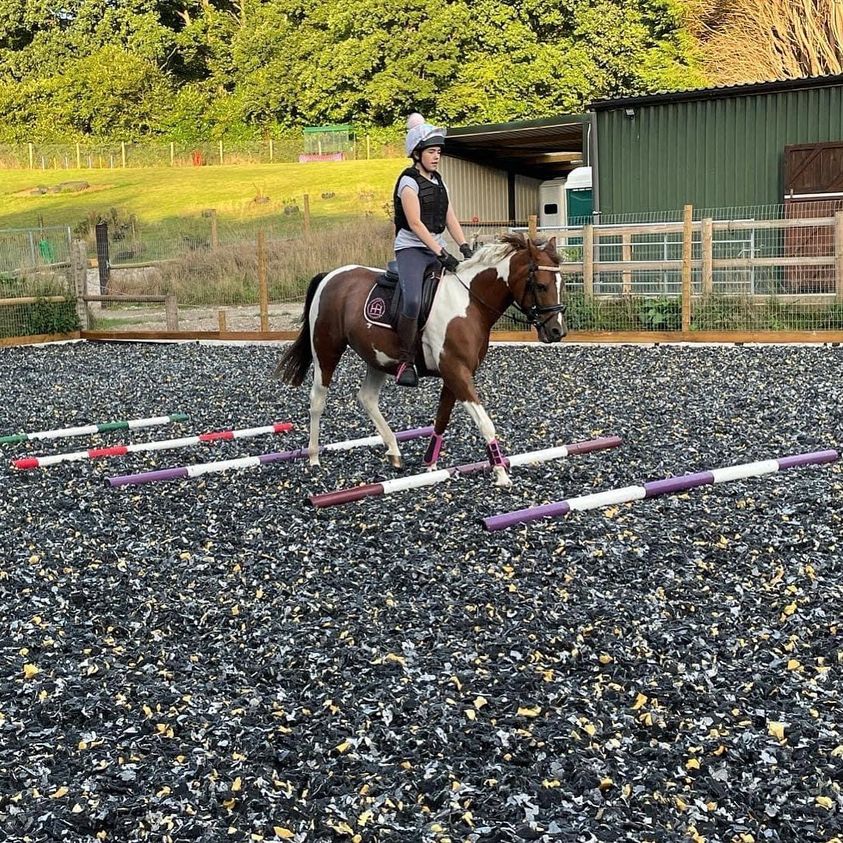
Polework has long been a staple of effective equestrian training, but it is far more than a way to add variety to a schooling session. Modern research and practical experience consistently show that polework plays a valuable role in improving equine biomechanics, strength, coordination, and long-term soundness when used correctly.
When horses walk or trot over poles, they are required to adjust stride length, timing, and limb placement. This deliberate movement increases joint range of motion and encourages greater flexion through the shoulder, hip, and hock, supporting more efficient and balanced movement patterns.
Unlike repetitive flatwork, polework challenges the horse to move with intention and control. This promotes symmetry between left and right sides, helping to address unevenness and supporting more consistent, correct biomechanics across all disciplines.
Polework naturally encourages horses to engage their core muscles and lift through the back. As the horse steps over each pole, the abdominal muscles activate, allowing the back to round and the topline to develop correctly. Over time, this leads to improved self-carriage, greater stability, and a horse that can move with enhanced suppleness and strength.
Because the work is controlled and progressive, pole exercises allow muscle development without placing excessive strain on joints or soft tissue. This makes polework an effective component of both conditioning and rehabilitation programmes, along with everyday schooling routines.
One of the most significant benefits of polework is its impact on proprioception – a horse’s awareness of where their body and limbs are in space. Stepping over poles requires focus, accuracy, and coordination, helping horses develop better balance, rhythm, and stride regulation.
Improved proprioception is particularly valuable for:
Due to its low-impact nature, polework is widely used in rehabilitation and injury-prevention programmes. When introduced appropriately, it allows horses to rebuild strength, coordination, and correct movement patterns without the repetitive loading associated with jumping or intensive schooling.
For many horses, polework provides a safe and effective way to maintain fitness, improve movement efficiency, and support longevity in training.
While the benefits of polework are well-established, the surface on which it is performed is critical. Consistent, forgiving footing reduces concussion on joints, provides secure traction for accurate foot placement, and supports repeated practice without unnecessary strain.
A poorly designed or inconsistent surface can limit the benefits of polework and increase the risk of uneven loading or injury. This is why surface quality should always be considered part of the training equation – not an afterthought.
At Foleys Equestrian, our performance surfaces are designed to support correct movement, offering the stability and shock absorption required for effective polework at all stages of training.
At Foleys Equestrian, polework is not treated as a filler exercise, but as a purposeful training tool that supports soundness, performance, and long-term equine wellbeing. When combined with thoughtful training and the right surface, polework becomes one of the most versatile and scientifically supported tools in modern equestrian practice.
Never miss a hoofbeat! Join our mailing list to keep you up to date with the latest news, event reports, articles, training tips, horse health news, and more.
Company registered address: Layland Road, Skelton-In-Cleveland, Saltburn-By-The-Sea, TS12 2AQ
© 2024 All rights Reserved. Company number 11647819.
Foleys Equestrian Ltd (Company No. 16647819) is a newly incorporated company, registered in August 2025 and trading from December 2025. It is a separate and independent legal entity and is not part of, connected with, or a continuation of Foley’s Equestrian Surfaces Ltd.
Foleys Equestrian Ltd has not acquired the business of Foley’s Equestrian Surfaces Ltd, nor has it assumed any liabilities, obligations, or responsibilities of that company. Foleys Equestrian Ltd cannot deal with, and accepts no responsibility for, any orders, contracts, warranties, guarantees, goods, services, complaints, or claims relating to Foley’s Equestrian Surfaces Ltd, whether entered into before or after December 2025.
Any references, enquiries, or communications intended for Foley’s Equestrian Surfaces Ltd should be directed to that company and not to Foleys Equestrian Ltd.