

Building a horse riding arena can feel overwhelming – especially when it’s for your beloved horses. It’s important to get it right for both their wellbeing and your budget.
There’s no one-horseshoe-fits-all approach, and there are no real shortcuts. Careful planning from the outset – right through to completion – will help ensure your arena project runs smoothly and keeps unexpected costs under control.
Whether you’re starting from scratch or upgrading an existing arena, you’re already on the right track by being here. So pop the kettle on, grab a notepad, and let’s get started.
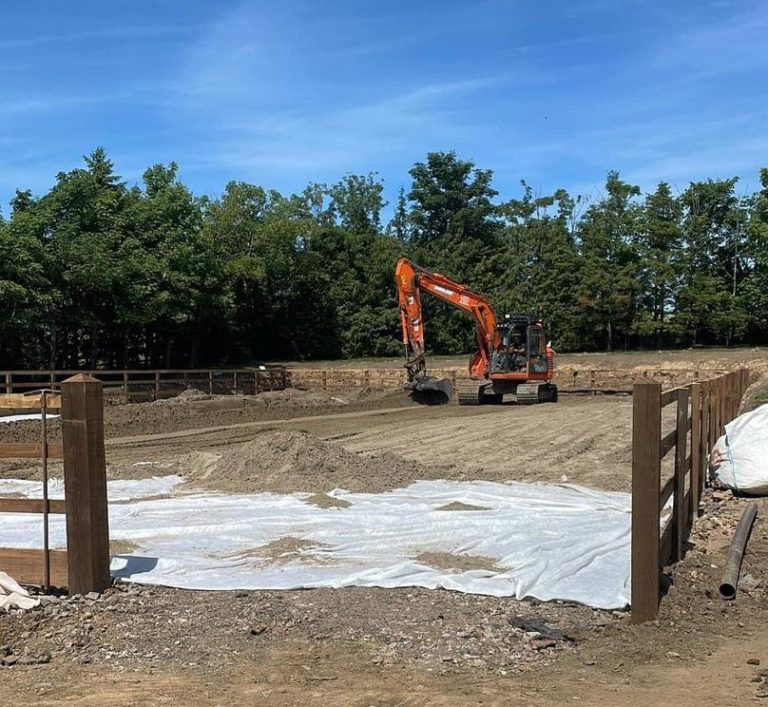
Before you begin constructing your arena, careful planning is essential. Taking the time to assess regulations, site logistics and environmental factors early on can prevent costly setbacks later in the project.
Planning requirements vary depending on your location, so always confirm whether permission is required before starting work. In some areas, constructing a horse riding arena may need formal planning approval – particularly if you are changing land use, installing lighting, or altering ground levels.
Environmental considerations are also important. If your drainage system will discharge into a ditch, stream or public watercourse, you may need consent from the relevant authority. Securing approvals early avoids delays once groundworks are underway.
Where possible, schedule construction during drier months. Wet ground can quickly become unstable under heavy machinery, leading to additional excavation work and increased costs. Working in favourable weather conditions also helps achieve better compaction and levelling results.
Think carefully about access to the site. You will need space for excavation equipment, stone deliveries, drainage materials and surface supplies. Restricted access can increase labour time and haulage costs, so ensuring clear entry points from the outset will make the entire build more efficient.
Proper planning at this stage sets the foundation for a smoother, more cost-effective arena build.
Selecting the right site for your arena is one of the most important decisions. Even the best drainage system and surface materials cannot compensate for poor placement, so taking time to assess your land properly is crucial.
Examine the natural lay of the land carefully. Ideally, your arena should be positioned on slightly elevated ground so it only needs to manage rainfall falling directly onto it — not surface water running down from higher areas.
A gentle, controlled fall will allow water to drain evenly away from the arena, reducing the risk of pooling and long-term structural issues. Building on higher ground immediately gives you a drainage advantage.
Look for firm, well-draining soil wherever possible. Avoid low-lying, marshy or compacted areas prone to waterlogging, as these will require more extensive groundwork and drainage solutions.
If you already have a partially levelled area, this may reduce excavation costs and speed up preparation time – but always assess the underlying soil quality before proceeding.
A suitable drainage outlet is essential. Ensure there is a practical route for water to be carried safely away from the arena, whether into a ditch, soakaway or approved watercourse.
Positioning the length of the arena north to south helps maximise natural sunlight exposure throughout the day. Increased sunlight supports faster surface drying and helps maintain consistent riding conditions.
If soil conditions are weaker, installing a high-quality geotextile membrane can improve ground stability and prevent contamination between subsoil and sub-base layers – protecting the long-term integrity of your arena.
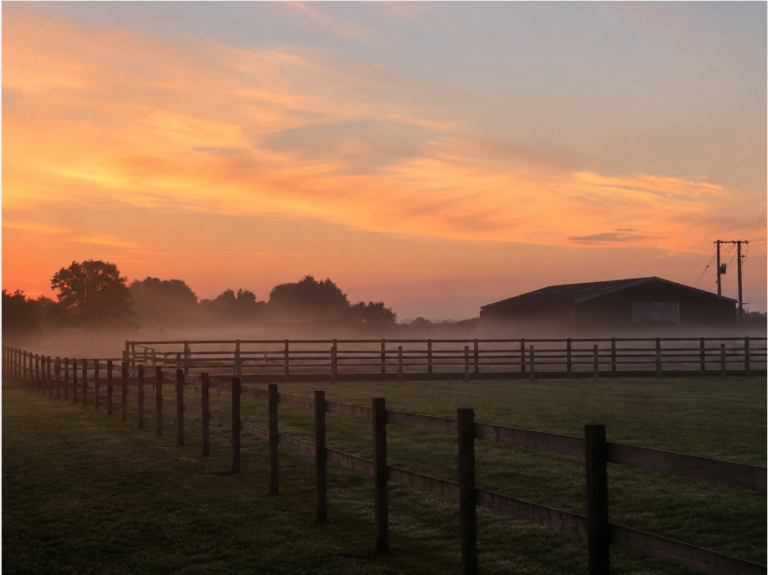
When constructing an arena, size plays a major role in both functionality and overall cost. A compact lunge pen will naturally require less excavation, drainage, stone and surface material than a full-size competition arena – so defining your needs early is essential.
Start by thinking about how the arena will be used. If it will mainly serve novice riders or general schooling purposes, a smaller arena may be perfectly suitable. A standard riding arena size for training is 20m x 40m, while a full competition dressage arena measures 20m x 60m.
If you plan to host clinics, competitions, or train at higher levels, building to regulation size from the outset may be a worthwhile long-term investment.
The size of your property, existing buildings, boundaries and natural landscape will influence what is realistically achievable. It’s important to ensure there is adequate space not only for the arena itself, but also for drainage, fencing, access routes and safe standing areas around the perimeter.
Access to the site can significantly affect costs. Limited entry points may restrict machinery size, increase labour time, and complicate the delivery of stone, membranes and surface materials. Planning for efficient access helps keep construction time and expenses under control.
Choosing the right dimensions from the beginning ensures your arena meets both your riding goals and your budget – without needing costly alterations in the future.
Once the location and size of your arena have been confirmed, careful site preparation is the next critical stage. Proper groundwork lays the foundation for everything that follows – particularly drainage, stability and long-term performance.
Clearly mark the full footprint of the arena, allowing at least 1 metre extra around the perimeter. This additional working space enables machinery to manoeuvre safely and ensures edges are properly compacted and supported.
Accurate setting out at this stage prevents costly adjustments later.
All topsoil, grass and organic material must be removed before construction begins. Topsoil has poor load-bearing capacity and retains moisture, making it unsuitable as a base for any riding arena. Leaving it in place can lead to uneven settlement, instability and drainage failure over time.
The exposed ground should be carefully levelled and shaped to create a gentle, controlled fall towards your designated drainage outlet. This ensures surface water moves efficiently away from the arena, preventing pooling and protecting the integrity of the sub-base and surface layers.
Taking the time to prepare the site correctly at this stage will significantly reduce the risk of future structural and drainage problems.
We want an arena, not a swimming pool (although that would be nice too!) …
A well-designed drainage system is fundamental when constructing a riding arena. Without effective water management, even the best surface materials will fail. Drainage must remove excess water efficiently, without eroding the surface layers or compromising the arena’s structure. It is this system that allows you to achieve a true all-weather arena.
The drainage solution you install will depend on your soil type, land gradient and intended arena use. However, most systems follow the same principle: smaller collecting drains feed into a larger main outlet, which safely carries water away to a ditch, soakaway or approved watercourse.
The most commonly used drainage system is the herringbone pattern. This consists of:
Drainage pipes should be installed in trenches approximately twice the depth of the pipe diameter, allowing adequate space for surrounding stone. The trenches should be lined with a woven geotextile membrane to prevent silting and contamination from surrounding subsoil.
Without proper protection, drains can quickly clog – leading to standing water and costly remedial work.
The edges of an arena often experience the most wear and foot traffic. Installing a perimeter drainage trench outside the arena boundary can help prevent water pooling around fencing, kickboards and standing areas.
Allowing water to sit around the outer edges increases the risk of timber damage, surface breakdown and long-term structural issues.
Getting the drainage right from the outset protects every layer above it – from the sub-base through to the final riding surface.
There’s more than just what you see on the surface… Once drainage channels are installed and the formation level has been prepared, the next stage is installing a high-quality geotextile membrane. This layer plays a critical structural role.
The entire arena footprint should be covered with a strong, woven geotextile membrane. This permeable, high-tensile fabric separates the clean sub-base stone from the underlying soil, preventing contamination while still allowing water to pass through into the drainage system.
Without this separation layer, subsoil can migrate upward into the stone, reducing drainage efficiency and weakening the foundation over time.
The drainage trenches should also be fully lined with the same membrane. This protective wrap helps prevent silting and stops fine particles from entering and blocking the pipework – significantly extending the lifespan of your drainage system.
All membrane joints should overlap by a minimum of 300mm and be securely sealed using appropriate tape, adhesive, or heat bonding. Poorly sealed joins can allow movement or contamination between layers.
Before laying drainage pipes, install a base layer of clean, washed 20–40mm shingle within the lined trenches. The pipework should then be positioned on top of this stone bed.
Once all pipes are correctly aligned and connected, backfill the trenches with additional clean shingle until level with the surrounding formation.
At this stage, the arena base should be level, protected, and ready for sub-base stone installation.
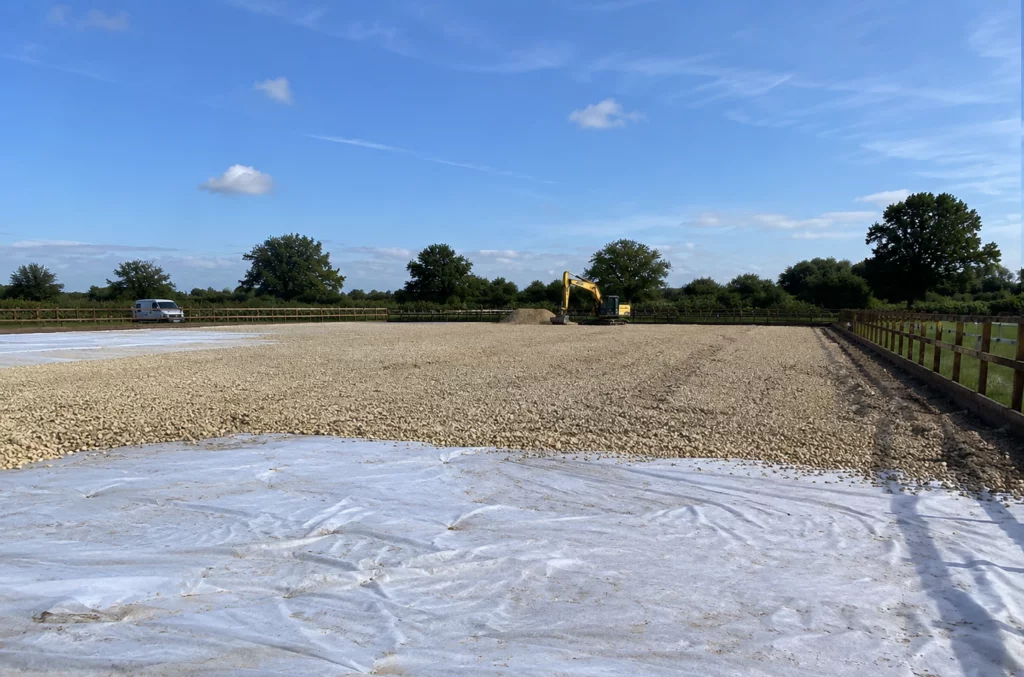
The sub-base is the structural foundation of your arena. When constructing a horse riding arena, this layer is just as critical as the drainage system itself. It provides additional water dispersal while creating a stable, load-bearing platform for the riding surface above.
The sub-base should consist of clean, washed, frost-resistant, angular stone. Angular aggregates interlock when compacted, forming a firm yet free-draining base.
Typical compacted depth is 150mm (6 inches), although this will depend on ground conditions and intended usage.
Suitable materials may include:
Limestone
Granite
Crushed concrete
Material choice often varies depending on your location in the country, but whichever aggregate is selected, it must be clean and free from fines.
Avoid:
Unwashed or dusty aggregates (these clog drainage systems)
Oversized bricks or rounded stones (they do not compact or interlock effectively)
Stone that is not frost-resistant
A simple frost test can be done by knocking two stones together – if they crack, crumble or produce dust, they are unsuitable.
Remember to allow for compaction when calculating quantities. A loose depth will reduce once rolled and compacted.
The sub-base must be compacted thoroughly using a vibrating roller and laser levelling equipment to ensure an even, stable finish. Poor compaction can lead to movement in the upper layers and long-term surface issues.
The sub-base layer should extend approximately 500mm beyond the arena perimeter. This helps manage surface runoff and protects fencing, kickboards and surrounding boundaries from water damage.
Important:
Inadequate drainage or sub-base preparation will undermine even the highest-quality riding surface. Getting these structural layers right from the outset protects your investment and ensures long-term arena performance.
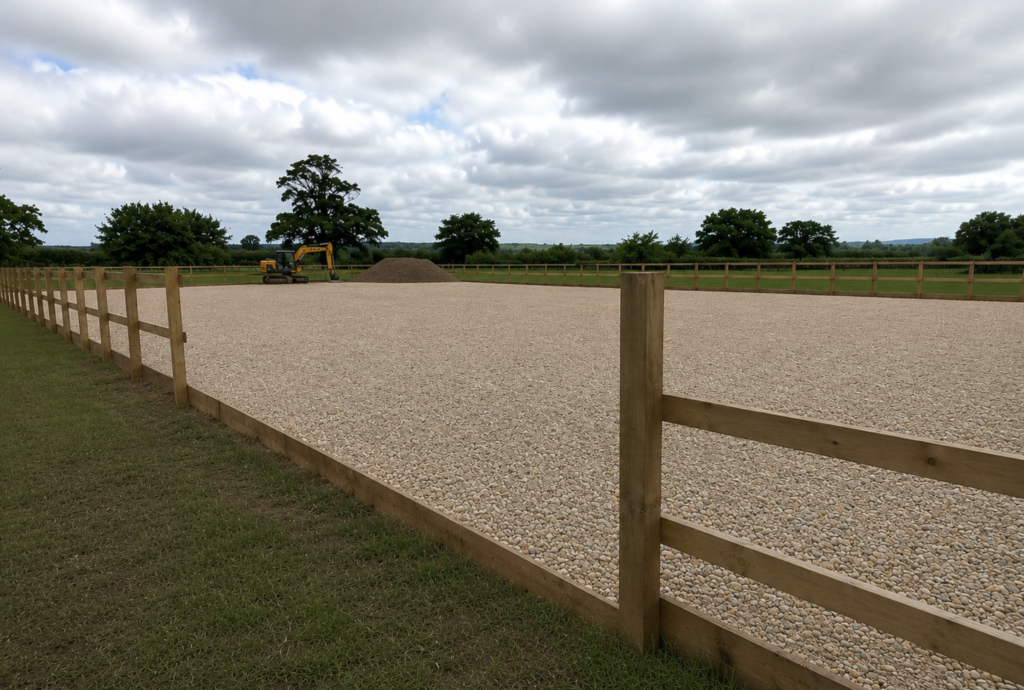
A strong, well-designed perimeter is an essential element of any horse arena. It not only defines the arena space but also protects the footing, keeps horses safe, and supports long-term structural integrity.
Install post-and-rail fencing with retaining or kick boards along the arena perimeter. Kick boards help contain footing, reducing wear on the edges, and provide an extra layer of protection for horses and riders.
Strainer posts should be placed at each corner to provide additional strength and stability to the fencing structure. Properly installed corners help the fence withstand impact and prevent leaning over time.
Rails should be ideally be fixed from the inside-out, minimising the risk of injury to horses or riders. For extra durability, stagger the ends of each rail so they don’t all finish at the same post.
Allow for natural expansion and contraction caused by weather by leaving a small gap between joins. This simple step prevents warping, splitting, or misalignment over time.
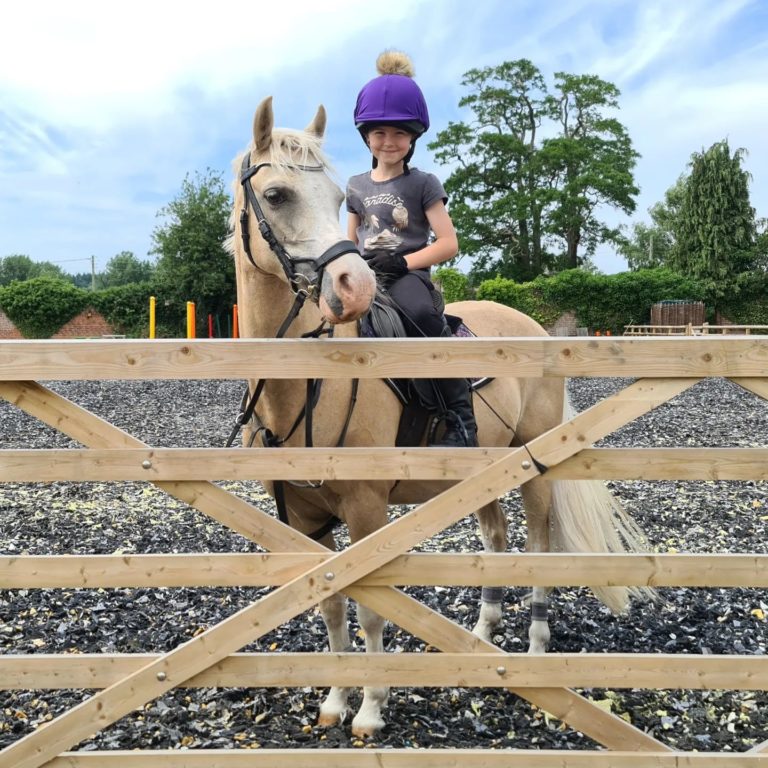
Position gates to accommodate both horse movement and equipment access. Ensure they are appropriately sized for the types of horses using the arena and are easy to operate safely.
Using high-quality, durable timber or alternative materials ensures long-lasting performance and reduces maintenance requirements. A well-built perimeter not only enhances safety but also protects your investment in the arena surface.
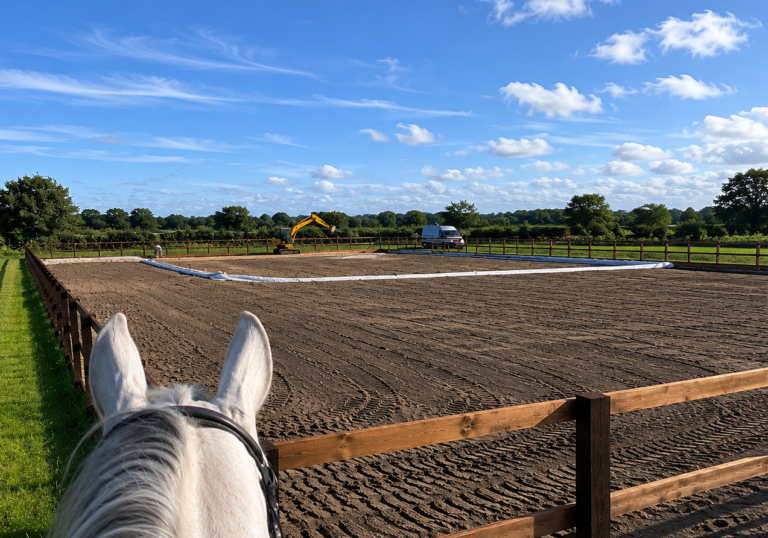
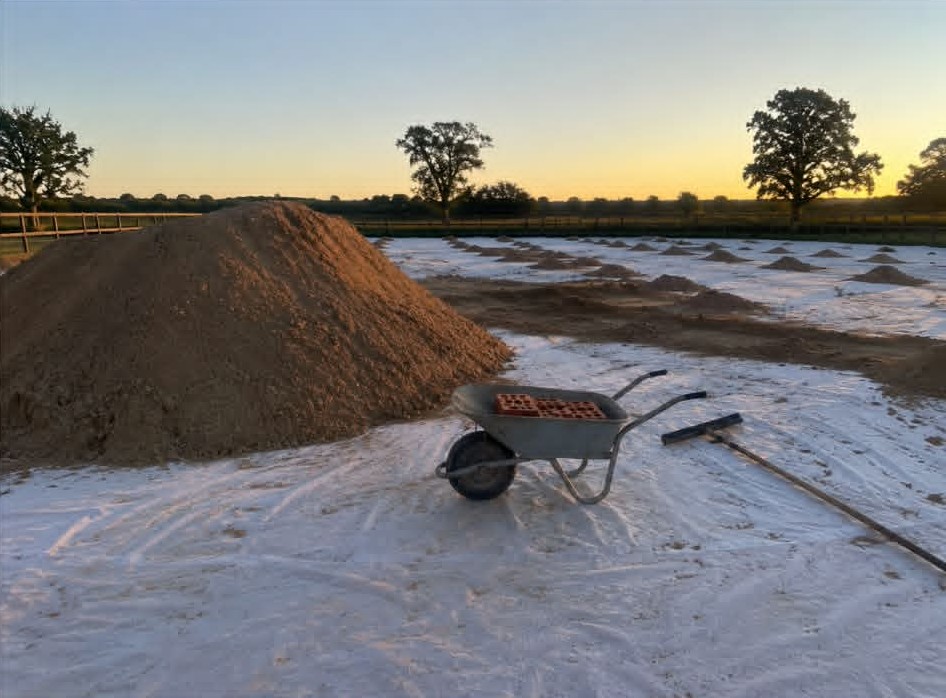
Before adding your arena’s top surface, it’s essential to install a non-woven geotextile membrane. This secondary layer acts as a protective barrier between the sub-base and your top riding surface, ensuring long-term stability and efficient drainage.
As with the first membrane, each roll must overlap sufficiently – typically 300mm or more – and be securely sealed using tape, adhesive, or heat bonding. Any gaps or holes can allow the top surface to penetrate the membrane, causing lifting or contamination.
Make sure the membrane extends over the arena’s kick boards or retaining edges. This prevents surface material from spilling down the sides, while still allowing trimming after the top surface is laid for a neat finish.
This non-woven layer does more than just separate surfaces:
Prevents contamination between the sub-base and top layer, maintaining arena integrity
Acts as an additional water filter, allowing surface water to drain efficiently into the underlying drainage system
Installing this membrane correctly protects all the groundwork completed so far, ensuring your final arena surface performs consistently, safely, and all year round.
The final furlong… Your riding surface is arguably the most important part of constructing an arena. Choosing the right surface ensures safety, performance, and longevity, tailored to your discipline, whether it’s showjumping, dressage, polo, or general schooling.
The ideal arena surface balances support, traction, and consistency. Surfaces that are too hard increase the risk of impact injuries, while surfaces that are too soft can overstretch muscles and tendons. A high-quality surface should also be:
With a Foleys Equestrian surface, you gain all these all-weather benefits at a cost-effective price.
Tip: If you can dig down to the membrane with your heel, this layer is too soft and may compromise the arena.
Installing the correct surface completes your arena construction, providing a safe, durable, and high-performance environment for horses and riders alike.
If you want to learn more about the surfaces Foleys Equestrian have to offer, click the button to take you to our quality riding surface options.
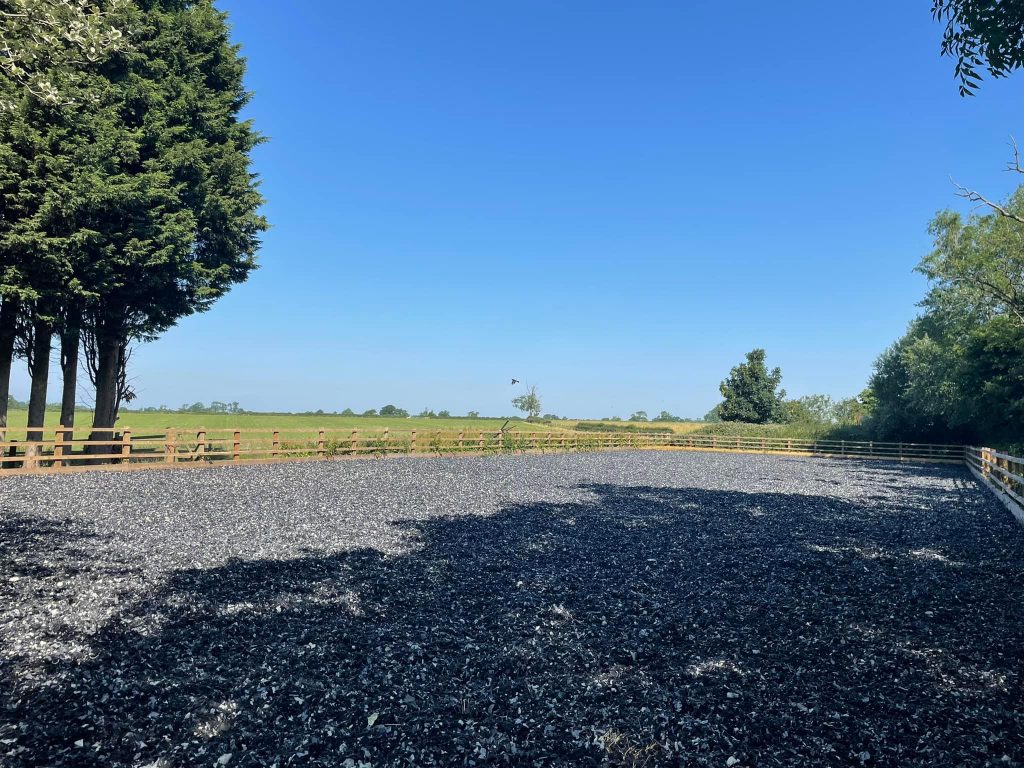
After all that time, money (and probably some stress), you want to protect the longevity of your arena. Even the best constructed horse riding arena requires ongoing care to maintain performance and longevity. Proper maintenance protects your investment, preserves surface integrity, and ensures safe footing for horses and riders.
Avoid using the arena immediately after heavy rainfall. Allow water to drain naturally before riding to prevent damage to the surface, sub-base, and membrane.
Harrow the surface to keep it even, especially along outer edges where traffic is heavier. Uneven wear can deepen tracks, potentially exposing the membrane and compromising arena performance. Foleys fibre surfaces experience minimal movement, so this step is less frequent than with traditional sand or rubber arenas.
Remove manure, weeds, and debris regularly. Organic matter can damage the arena structure and block drainage. Unchecked weeds can penetrate the membrane and sub-base, causing long-term problems.
Over time, the arena surface may require an additional top up to maintain optimal depth and consistency. Topping-up helps preserve footing quality and prevent uneven compaction.
Foleys Equestrian provides guidance on the best tools and techniques for maintaining their all-weather riding surfaces. Proper equipment ensures maintenance is effective, safe, and easy.
Tip: Think of building an arena like preparing for a Grand National, not a 5-furlong race. Careful, methodical planning and maintenance will ensure your arena performs well and lasts for years.
Even small oversights can have a big impact on your arena’s performance and longevity. Avoid these common pitfalls to ensure a safe, durable, and all-weather surface:
Building on low-lying or waterlogged ground can lead to persistent drainage problems, uneven footing, and accelerated surface wear. Always select a well-draining, firm site to prevent long-term issues.
Drainage and the sub-base are the backbone of any arena. Cutting corners on these stages may save money upfront but will cause costly repairs later, including surface failure and waterlogging. Proper preparation is essential for a high-performance, all-weather arena.
Cheap or unsuitable fencing can deteriorate quickly, risking safety for both horse and rider. Invest in durable posts, rails, and kickboards to protect the arena surface and ensure long-term structural stability.
Different equestrian disciplines require specific surface characteristics. Using an insufficient surface for your requirements can lead to injuries, inconsistent footing, or rapid wear. Always choose a surface that matches your horses’ and riders’ needs.
Tip: By avoiding these mistakes and following best-practice steps – from site selection to surface installation – you can create a safe, long-lasting arena that performs well in all conditions.
We hope you found this information useful. If you have any questions, please don’t hesitate to contact our experienced team.
Disclaimer:
The information provided above is offered in good faith and is believed to be accurate at the time of publication. However, site conditions, installation methods and product applications can vary significantly and are beyond our control. Foleys Equestrian accepts no liability for any loss or damage arising from reliance on this information. Customers are responsible for ensuring materials and installation methods are suitable for their individual project requirements.
Never miss a hoofbeat! Join our mailing list to keep you up to date with the latest news, event reports, articles, training tips, horse health news, and more.
Company registered address: Layland Road, Skelton-In-Cleveland, Saltburn-By-The-Sea, TS12 2AQ
© 2025 All rights Reserved. Company number 11647819.